Wednesday, 20 April 2016

MR. DISTRICT ATTORNEY (1947)


By Gary Deane


Him: “I’m shooting for the top. I want a wife who’s willing to do anything to get there.”

Her: “I think I know what you mean.”


For a time, fans of law-and-order champion Mr. District Attorney had their pick: an NBC radio program that aired 1939 to 1952; a DC crime comic that went 67 issues, 1948 to 1959; and a tail-end television series on ABC that ran from 1952 to 1953. During the war years, the anti-crime crusader also was lionized in a trio of Mr. District Attorney motion pictures released by Republic, and later in a post-war follow-up from Columbia Studios. The differences between the earlier and later productions showcase much of what film noir is about – and what it’s not.


Mr. District Attorney (1941), the initial Republic studios release, starred Stanley Ridges as intrepid D.A. Tom Winton and a young Dennis O’Keefe as his newly-minted Assistant, Prince Cadwallader Jones. The well-meaning but hapless Jones is keen to solve a stalled embezzlement case but finds himself running up against Terry Parker (Florence Rice), a nosey newspaper journalist who knows a good story when she sniffs one. But it’s Peter Lorre, in an appearance that’s perversely at odds with any of the rest of the film, who’s the best reason to watch it.

Shortly after, came Mr. District Attorney in the Carter Case (1941), with Paul Harvey as the D.A. and James Ellison and Virginia Gilmore in the roles of Jones and Parker. This one is highlighted only by its surprise ending and luminous lighting set-ups by cinematographer John Alton.


Next was Secrets of the Underground (1942), featuring Pierre Watkin as the District Attorney and John Hubbard and Virginia Grey as the accidental partners-in-crime-fighting. The moive has its minor rewards, including a timely script by Daniel Mainwaring (Out of the Past, 1947; The Big Steal, 1949; The Tall Target, 1951). Additional titles had been planned, but, in the end, Secrets of the Underground was as far as the Republic series was to travel.

Though the original Mr. District Attorney radio play opted for pure suspense, the Republic titles leaned more in the direction of the ‘mystery-comedy’ – a claptrap contrivance designed to offer ‘comic relief’ and let-up from the more serious matters at hand. But by the end of WWII, audiences were tiring of its stagy bag of tricks: the bumbling heroes and fast-talking sidekicks (or just the opposite), the usual double-takes, and the slapstick confusion. By the late ‘40’s, a flood of psychological thrillers and blood melodramas had largely swept all this away, save for a few creaky detective series like The Thin Man, Boston Blackie, The Falcon, Bulldog Drummond or The Saint in their final appearances (crime-for-laughs would survive as a moviegoing staple, but one increasingly better-fitted to the comedy).

Meantime, Columbia Studios decided to have another crack at Mr. District Attorney. The new version would star the venerable Adolphe Menjou as Craig Warren, D. A. as well as a more mature Dennis O’Keefe as Steve Bennett, Warren’s case-hardened Assistant. The feisty female journalist character– always ready to pitch in to help out – was tossed in favor of a venomous spider woman (played with deadly conviction by Marguerite Chapman) out for absolutely no one but herself. This more ominous turn was no big leap for Columbia, having had recent successes with darker offerings such as Gilda (1946), Framed (1947) and Dead Reckoning (1947) and B titles like Night Editor (1946).


That said, Columbia hedged its bets with a nod to the spirit of the earlier titles. There’s Menjou, ever the Hollywood dandy and stylized little-man with his waxed mustache and aggravated manner, whose presence recalls a bygone era;  also character actor Michael O’Shea as Harrington, Warren’s quick-as-a-quip investigator, and smiley-face Jeff Donnell as the office girl and blessed soul of patience. However, the vestigial hokeyness doesn’t detract from Mr. District Attorney's essence as a gripping film noir.


With a screenplay by Ian McLellan Hunter (who would later front for Dalton Trumbo until Hunter himself was blacklisted), Mr. District Attorney features a convoluted but well-anchored storyline. District Attorney Warren is under the gun to bring down the courtly but cold-blooded gangster, James Randolph (George Coulouris), who has the local rackets wrapped up, along with a cadre of crooked business leaders and government officials. To help build the case, Warren hires a former defense lawyer, Steve Bennett who’d been serving as counsel to one of Randolph’s cronies but then quit both his client and his law firm after discovering he’d been taken for a chump.

Keeping a nicely-mascaraed eye out for Randolph’s interests is Marcia Manning (Marguerite Chapman), his glamourous personal assistant. We learn soon enough though that Randolph wants her to be more than simply the hired help. However, Manning wants to hear more from him than just sweet nothings, reminding him, “To me, love is a luxury… You want me to be romantic like the songs about living on love and pale moonlight...I know how it works. My mother tried it and by the time she was 35 she was an old woman left with nothing except pale moonlight, and that’s not going to happen to me.”


In fact, a lot has already happened to Our Miss Manning, including managing to beat a murder rap back in Kansas City. Warren knows about this and figures that Manning might be the best and fastest way to get to Randolph. Manning, conversely, wastes no time in finding her way to Bennett and before long, she’s duped him into revealing information that sinks Warren’s case. Warren suspects his wide-eyed boy has been played for a sucker and sends Bennett out of the country on another investigation. He then brings in Manning and tells her to lay off Bennett or his office might revisit her legal problems. When Bennett returns and hears of this, he quits, only to later discover that Manning dumped him while he was gone. Bennett is furious, but, now without a job, lets Manning coax him into taking on some legal work for Randolph. However, as the plot thickens and bodies pile up, Bennett realizes that it’s Manning who’s really at the root of all evil and makes up his mind to do something about it. Manning, of course, has other ideas.  


The little-known Chapman grew up as a small-town tomboy in Chatham, NY.  Affectionately called “Slugger” by her friends, the beautiful brunette was encouraged by them later to try modeling. She went to New York and became a featured John Powers Girl and after she’d been on the cover of enough magazines, Hollywood came calling. Through 1940 to 1943, Chapman appeared in eighteen films, albeit minor ones. She later moved up several rungs on the studio ladder and became the female interest in several better Columbia features, including:  Destroyer (1943) with Edgar G. Robinson; Appointment in Berlin (1943) opposite George Sanders; and Counter-Attack (1945) with Paul Muni. After the war, there were a few more A features, notably Relentless (1948), a well-received western with Robert Young. But from there on, appearances became limited to supporting roles in movies and on television. By the mid-1960s, she’d effectively retired from the screen to focus on stage work.

None of which is to say that Chapman couldn’t or shouldn’t have had a much bigger career in movies. The actress at one time or another had been singled out by scribes for everything from her “comeliness” to her versatility “spilling over”. However, her striking beauty and versatility appeared to work just as much against her as for her in that she was never able to establish a dominant screen personality. Like Ruth Hussey or Barbara Hale to whom she shared a resemblance, Chapman didn’t easily evince a strike-up-the-band sparkle, domesticated warmth, or relaxed sexuality.


Mr. District Attorney on the other hand takes advantage of what Chapman did have: a sophisticated charm and self-possession free of overemphasis or bossiness. She’s a woman capable of living in a man’s world without looking for concessions, including marriage, which would happen only if and when convenient. 

Chapman also ups the ante as a femme fatale who never overplays her advantage. Like the most memorable femmes of classic film noir, Manning is knowable, but, forever and fatally, unreadable. Though Messrs. Mejou, O’Keefe, and Coulouris all give it their best, the film belongs to Chapman.

Unfortunately, Mr. District Attorney wasn’t a movie of the size or sort that could deliver a breakthrough for any actor, no matter how impressive the showing. It’s yet more unfortunate that there weren’t more opportunities for Chapman to be on screen what she obviously was meant to be. Sometimes things work out and sometimes they don't. After decades out of the business, she suddenly was first-call for the coveted role of ‘Old Rose’ Dason-Calvert in the 1997 James Cameron blockbuster, Titanic, but was prevented by ill-health from accepting. The part went to Gloria Stuart, who will be remembered forever for it. Chapman died two years later. 

Mr. District Attorney also was graced by cinematographer Bert Glennon, a confirmed but underappreciated visual stylist who was on camera for Juke Girl (1942), Shadow of a Woman (1946), The Red House (1947), Ruthless (1948), Red Light (1949) and the terrific Crime Wave (1954). Glennon’s mastery of the noir registry is on full display in Mr. District Attorney, starting with the film’s shocking opening scene, which as it turned out, would foreshadow the cold-blooded murder of its director, Robert Sinclair twenty-three years later. With its rich noir visualizations, smartly-plotted story, and industrious performances, Mr. District Attorney is a film noir worth watching straight down the line.


Gary Deane


(A longer version of this article appeared in NOIR CITY e-magazine).

Monday, 4 April 2016

LA NOCHE AVANZA (1952)


We managed to get ourselves over to Vancouver from Victoria, Sunday, April 3, for the Vancouver International Film Centre's screening of LA NOCHE AVANZA (NIGHT FALLS) 1952, Mexcian director Roberto Gavaldon's unseen film noir classic. The movie entirely lived up to its VIFF billing:

"This Gavaldón classic suggests that what the boxing world is to the Hollywood film noir, the high-speed game of pelota (jai alai) is to its Mexican cousin. Pedro Armendáriz, Mexico’s great romantic lead, plays against type as an arrogant pelotari who seduces and discards women at will, until he becomes the target of a cunning revenge plot. He meets his fate in a final image that is as quintessentially noir as it is inconceivable in a Hollywood film."

While LA NOCHE AVANZA is not available in video, Gavaldon's LA OTRA (THE OTHER ONE) 1946 and LA DIOSA ARRODILLADA (THE KNEELING GODDESS) (1947) both are. Seasoned noir fans will be thrilled.


Friday, 19 February 2016

A PLACE IN THE SUN (1951)

By Valerie Deane


Film noir…or not film noir? The question nags this movie like a toothacheWhich I have to say is baffling. It’s hard to imagine a film in which fate lays its hand upon a protagonist more heavily than in A Place in the Sun. Having just watched it again, I’m convinced more than ever that the film is truly, deeply noir.

But let’s begin at the beginning.

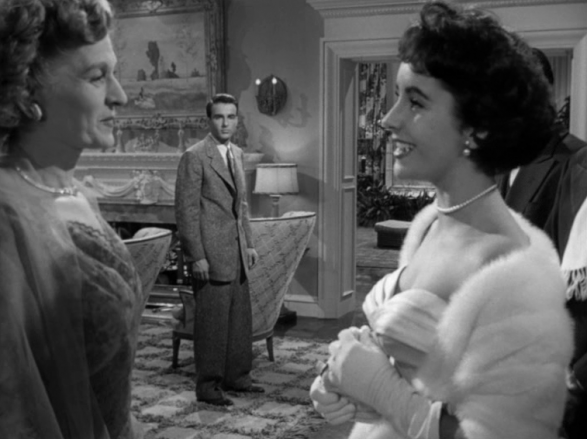
George Eastman (Montgomery Clift) is a young man from a working-class background who’s been given a chance to get ahead thanks to a wealthy family connection. But we know from the moment we see him hitching a ride to his new job, he’s not going to have an easy time of it.


Clearly ambitious, George covets the American Dream. But though he’s attractive and personable and shares a respected name, he’s not readily accepted by the Eastmans and their circle. Nor is he able to make friends with his co-workers since his uncle has forbidden social contact between family and employees. George becomes infatuated with one of the smart set, Angela Vickers (Elizabeth Taylor), who chooses to ignore him or just doesn’t see him. Disillusioned, he falls into a relationship with Alice Tripp, a factory girl who’s as lonely as he is. Played by Shelley Winters, she’s a plain but friendly young woman who clearly relishes the attention.


George for a time seems content with it all. Though he’s uneasy flouting his uncle’s rules, he feels he’s not doing  badly – he has a steady job, some money to spend, a room, a car, a girl, perhaps a future. It’s a far cry from living at his mother’s mission, finishing his schooling  at home, and working as a bellhop.

But then fate begins to show its ultimately deadly hand. At the moment that George and Alice’s relationship becomes intimate, his uncle promotes him and invites him – now as one of them - to the Eastman home. He’s formally introduced to Angela who now sees him as an Eastman. She flirts shamelessly with him and the attraction between these two impossibly beautiful people is immediate and intense.


However, it doesn’t take long for things to start to unravel. Alice announces to George that she’s pregnant and although at first he insists that he’ll marry her, he begins to retreat from her as he’s drawn further into the Eastman circle and to Angela. His place in the sun, now tantalizingly close, is all he can think about. Alice, angry at being neglected, threatens to tell all and undo the idyllic romance. George is distraught. His relationship with Alice is now the only barrier to the fulfillment of his dream. He feels that the fates are conspiring to send his life spiraling out of control. However, what he thinks of as ‘the fates’ could be his own moral frailty – the actions he’s taken, the choices he’s made, and his inability to deal with the consequences.


But then Angela suddenly provides George with what he thinks could be a solution to his problem. In passing, she mentions a drowning at the lake. He listens carefully. Angela has become an accidental femme fatale who causes him to stumble into a classic dead-end street where murder looks like the only way out. George moves ahead with a plan to kill Alice, but it’s hastily conceived and it’s clear that he’s ill-equipped to commit such a crime.


He takes Alice rowing on the lake but what happens is not what he’d planned. At the critical moment, he’s unable to kill her. Then Alice accidentally stumbles and falls into the water. Panic-stricken, unable to swim, she will drown. George has a chance to save her (as well as himself) but is unable or unwilling to do so and Alice dies – exactly as he’d wanted.

What is George to do? He could report the accident and face up to the consequences. But if he did report it, would anyone believe him? He had set out with the intention of killing Alice and given his premeditation, his innocence might be hard, if not impossible, for him to argue. The line between guilt and innocence is blurred at best. We know Alice had told George that she was afraid of water and couldn't swim. We see his reaction to Angela’s telling of the drowning at her lake. We watch him listen to the news report on weekend accidents with aroused interest. We listen to him lie to Alice with greater frequency and ease. We feel his anticipation as a plan takes form. And in the end, Alice dies because he makes no attempt to save her.


With his religious upbringing, George knows that guilty thoughts count as much as guilty deeds. There is no way out – he is doomed and he knows it. With scarcely a word in his own defense, he succumbs to the inevitable - capture, trial, condemnation. Unwilling to act to save his intended victim’s life, he’s unable to move to save his own. His loss of moral certainty, his vision of himself as the victim (rather than Alice or even Angela), and his inability to see the inevitable and tragic consequences of his actions place him at the very center of the noir universe.

Visually, A Place in the Sun registers as high noir. High-contrast lighting and multiple off-angle camera shots emphasize the drama’s overwhelming sense of despair. In one striking scene, George is on the first day of his new job only the morning after Alice has told him she’s pregnant. The film’s director George Stevens frames his interiors to suggest George trapped in a cage – an indication of his state of mind and a foreshadowing of the prison cell waiting. Stevens even subverts our appreciation of exteriors of great natural beauty, rendering them ominous and ill-disposed.


Costuming in A Place in the Sun also is central to its sense of noirness. Angela is dressed either in white or in black depending on whether she’s seen as part of George’s place in the sun or conversely as the catalyst for Alice’s death. George is dressed in light tweeds on his first visit to the Eastman family and is both dwarfed by the chair in which he is sitting and made invisible by the pillars and grandeur of the home. However, as he is accepted into that social circle, George’s clothing becomes darker and he increasingly dominates the scene.


A Place in the Sun is based on Theodore Dreiser’s epic novel, An American Tragedy, which runs over a 1,000 pages. Stevens replaces the sweep and detail of the novel with an intensity and focus that charts George’s incremental progression from an innocently ambitious young man to a confused, guilt-ridden wretch condemned for murder. As he’s led to his execution, his fellow inmates express the hope that he’s headed for a better world than the one he has known. Ironically, he was just beginning to know how good his world could have been. A place in the sun could have been his if he hadn’t been so blinded by the desire for it that he was prepared to do anything, even murder, to attain it. How could anything be more noir than that?


Valerie Deane

Friday, 5 February 2016

JAIL BAIT (1954)


By Gary Deane

“There is nothing is more exhilarating than philistine vulgarity.”  Vladimir Nabokov


Once upon a time, Friday night wasn’t Friday night on college campuses without a screening of one or both of Ed Wood’s famously bad Plan 9 from Outer Space (1956) or Glen or Glenda (1953), a demented cult classic that baffles to this day. The latter is notable for its groundbreaking if unhinged portrayal of LGBTQ issues (Wood himself was an enthusiastic cross-dresser, with a particular fondness for angora).  

Wood’s story is well-known (if not entirely understood),  thanks to Plan 9’s epic exposure on late-night television beginning in 1961, followed by its citing as ‘The Worst Film Ever Made’ in Michael Medved’s best-selling book The Golden Turkey Awards (1980). Wood had become an object of cult fascination himself, an obsession fed by the release of Tim Burton’s Ed Wood (1994), one of The Best Films Ever Made Not to Receive an Oscar Nomination.  


In 1947, Wood came to Hollywood and began writing scripts and directing commercials and TV pilots along with several micro-budget westerns.  Glenda or Glenda was Wood’s first feature and it was a miracle that he ever got to direct another one.  However, two years later Wood teamed up with Alex Gordon, a writer from the UK and they set to work on a grungy little crime drama, Jail Bait. Gordon, who would go on to co-found American International Pictures, provided Jail Bait a semi-coherent storyline and some narrative flow, something to which few other Ed Wood films can lay claim. 


Jail Bait opens with Don Gregor (Clancy Moore), the wayward son of a world-famous plastic surgeon getting bailed out of jail by his sister, Marilyn (Dolores Fuller), for possession of an unregistered firearm. Keeping an eye out are the two cops in charge of the case, played by Lyle Talbot and a pre-Hercules Steve Reeves in his first shot at stardom. The pair knows that Gregor's fallen in with a low-rent gangster, Vic Brady (Timothy Farrell) who together have pulled off a couple of small-time heists.
  
When Don gets home, he grabs another gun and goes out to meet Vic. They go off to rob a movie theater, but not before the action cuts to a striptease show (in some expurgated versions of the film, it’s a blackface minstrel show), which has nothing to with anything. Later the robbery goes awry when Don panics and all hell breaks loose. Vic subsequently kills Don and forces Don’s father, a surgeon, into giving him a new face. However, the good doctor discovers his son's body at Vic’s apartment and makes plans to take his revenge.


Doctor Gregor is played by Herbert Rawlinson, a former silent-era leading man who scratched out a living afterward by taking any roles he could get, most of them uncredited.  It’s hard to say who gives the worst performance in Jail Bait but the winner might be Rawlinson, who has the lion’s share of bad dialog in a film that revels in it. As he says after a hard day at the office, “You know, I had to perform a very difficult operation this morning…and it was very strenuous and complicated. Plastic surgery seems to me at times to be very, very, complicated.” And, "This afternoon we had a long telephone conversation earlier in the day”. Maybe it was just as well that Rawlinson died the night after shooting his last scene in the movie. All this and sets and décor so impoverished and tacky that one of the biggest laughs comes when Fuller calls Brady a "cheap crook", only to have his girlfriend, Loretta (Theodora Thurman exclaim, “Cheap? Just look at the place! Vic is anything but cheap!” 

     
Given that the film's budget was only $21,000 for a 4-day shoot, Wood did well by it and there’s arguably something more to the production than might meet the uncommitted eye. Jail Bait is the closest Wood ever came to making a legitimate movie and entering the Hollywood mainstream. Though he was out of his depth as a director, especially with actors, the movie manages to be more enjoyable than a lot of the run-of-the-mill crime dramas and B noirs of the day far less suspenseful. Jail Bait’s wacko plot and daft dialog are all just part of the movie’s aberrant charm. It’s so consumed with its own internal logic and so thickly riddled with clichés that they almost stop being clichés and the movie takes on a strange, otherworldly sense of its own (Or almost of its own. Looking to cut corners, Wood used the same dream-like flamenco-guitar score as he did in Mesa of Lost Women, 1953).  

A big chunk of Jail Bait’s perverse allure can be credited to Timothy Farrell, an actor with mustachioed good looks, an authoritative baritone, and a smarmy, suspect manner. Farrell actually was purpose-built for film noir and played the lead in half a dozen crime titles involving Wood. The problem for Farrell was that he wasn’t that much of an actor and Wood was just about the only one who would hire him. But no matter how chintzy the production, incongruous the story, or cheap the patter, Farrell managed at least to give a conscientious performance, one often at sizeable odds with material. Maybe he just had ambitions at sizeable odds with reality. 


Farrell, born Timothy Sperl, grew up in Los Angeles and after serving in the Army Air Corps in WWII, got a job as a bailiff with the Los Angeles Marshal’s Office. Around the same time he started getting bit parts in low-rent B titles. The first was Test Tube Babies (1948) in which he plays a sympathetic doctor who counsels a young couple that there’s no shame or scandal in test tube fertilization and artificial insemination. Of course, the information is sandwiched between plenty of nudity, some wild parties, and cat fight.

Farrell’s bedside manner won him a similar part in Hometown Girl (1949) another ‘sex hygiene’ film that dealt with unwed motherhood. Both films had been produced by schlockmeister George Weiss who then cast Farrell as a scumbag gymnasium owner and drug pusher in a trio of crude quickies, The Devil’s Sleep (1949), Racket Girls (1951), and Dance Hall Racket (1953). The first of them was mostly an excuse to showcase endless lengths of female-wrestling and cat-fighting footage, the last a cheesy curio written by and co-starring stand-up social satirist and fall-down substance abuser Lenny Bruce who died of a morphine overdose at age 40.  


Shortly after, Farrell appeared in another seedy Weiss-produced title Paris after Midnight (1951) which boasted famous stripper, Tempest Storm. During production, Farrell along with everyone else on the set was busted in a highly-publicized vice-raid, never a good thing to happen to a sworn peace officer.

However, none of it seemed to stick and in 1954 life met art when his legal and theatrical careers dove-tailed in the George Cukor film, A Star is Born in which he was cast as an officer of the court. It happened again when Farrell secured a regular part as court bailiff in a late ‘50s television series, Accused, featuring, among others, Robert Culp and Pamela Mason.  
    
Farrell’s screen career ended in 1957. Meantime, he’d managed to hold on to his job in the Los Angeles County Marshall’s Office and rose through the ranks and was appointed County Marshall in 1975. He was fired four years later, following his conviction on corruption charges. 

The legacy of Ed Wood lives on with events such as the University of Southern California’s annual ‘Ed Wood Film Festival’ at which students are charged with writing, filming, and editing an Ed Wood-esque short film based on a predetermined theme. His movies were spoofed on the much-loved Mystery Theater 3000 and several remade as pornographic features. Many of his bizarre transvestite-themed sex novels have been republished.

Wood also established a theme with Jail Bait that he would return to several times: that weak-willed parenting can lead to disaster. This was hinted in Glen or Glenda, then given full-throat in Jail Bait and The Violent Years (1956), a juvenile delinquency yarn in which a rich and spoiled girl with indulgent parents forms a vicious girl gang with a penchant for robbing gas stations. It's just what happens. 


Gary Deane

Tuesday, 5 January 2016

TEN NOIRWORTHWATCHING 2015

1. SICARIO (United States)


2. VICTORIA (Germany)


3. '71 (United Kingdom)


4. GLASS CHIN (United States)


5. CUT SNAKE (Australia)


6. PHOENIX (Germany)


7. THE CONNECTION (France)


8. A MOST VIOLENT YEAR (United States)


9. WILD TALES (Argentina/Spain)


10. BLOODLINE (United States)


But enough of that. Let's try some of this.

THE WRECKING CREW (United States)


And a Happy Noir Year to All!

Gary Deane


Monday, 23 November 2015

MORE THAN MOLLY X: THE STORY OF JUNE HAVOC


By Gary Deane

Though unlisted among Eddie Muller’s storied Dark City Dames or Karen Burroughs Hannsberry’s  Bad Girls of Film Noir, Hollywood actress June Havoc featured in six pitch-dark crime dramas over a five-year period which might count her in as a true “sister under the mink”. 

Havoc’s personal and professional story up to that time is legend, revealingly told by the actress herself in two candid autobiographies, Early Havoc (1959) and More Havoc (1980). Those who know the gorgeously gaudy Jules Styne/ Stephen Sondheim Broadway musical Gypsy will remember the refrain “My name is June, what’s yours?”, delivered by Baby June, the curly-haired moppet. The show was inspired by her early life on the vaudeville circuit and that of her famously ambitious stage mother, Rose Thomas Hovick, and older sister, Rose Louise, who became Gypsy Rose Lee, celebrity burlesque queen and striptease artiste. 

Although Havoc acknowledged the greatness of Gypsy as a musical production, she otherwise contested it, asserting that it was a hurtful misrepresentation of her own part of the story. However, it seems that from a very young age Havoc had had to fight hard for her share of whatever was owed, including a mother’s love.


Havoc was born in Vancouver, Canada in 1912 but moved stateside with her mother and sister while still an infant. At age two, she was playing bit parts in silent films. By age five, she was a headliner on the Keith Orpheum Circuit in vaudeville earning $1500 a week. 

But Mama Rose kept June on the road well past the cute stage. Frustrated and weary of the grind, Havoc tried to escape when she was fifteen by marrying a boy in the show. However, the marriage was short-lived and she went back on the circuit until it collapsed early on during the Great Depression. To survive, she gutted it out in dance marathons, the experience of which she evoked vividly in a 1963 play Marathon 33 which garnered Tony nominations for both its direction and for Julie Harris as a young vaudevillian named June.

In 1936 at age 23, Havoc began to appear regularly in Broadway musical comedies. A big break came four years later in 1940 when she starred alongside Gene Kelly as Gladys, a nightclub performer in the Rodgers and Hart hit Pal Joey. One critic wrote, “June Havoc, who has been Gypsy Rose Lee’s sister so long she is sick of it, came into her own as a musical comedienne.”


Now into her twenties, Havoc had developed into a striking blonde beauty and a natural stage actress. At this point, Hollywood could not stay away. In 1941, Havoc made an impressive feature film debut in Four Jacks and a Jill with Ray Bolger and Anne Shirley. The following year she starred with Bert Lahr and Buddy Ebsen in Sing your Worries Away in which she took off her clothes in a pointed take-off of her sister. Other supporting parts followed in My Sister Eileen (1942), a successful Fox musical Hello, Frisco (1943), and Brewster’s Millions (1945), thought to be the best of the several screen versions of the popular play. 

Though the roles were small, her performances were all well-received. But Havoc wanted larger parts in less airy productions. She’d starred earlier on Broadway as Miss Sadie Thompson in Rouben Mamoulian’s re-working of Rain which had provided her the experience and the confidence to contemplate more serious roles. Then in 1947, she was cast in Elia Kazan’s Gentlemen’s Agreement as Gregory Peck’s secretary, a self-hating Jewess who had changed her name to the more ethnically-neutral ‘Elaine Wales’ in order to work for Peck’s virulently anti-Semitic magazine. Though Havoc received nothing but praise for her performance, nothing bigger came of it. 


Havoc was now 35 years old and neither a fresh face nor an established attraction. She’d also elected not to be put under studio contract so as to be able to continue to accept stage work. And in October 1947, she flew to Washington with a group of actors and directors that included Gene Kelly, Humphrey Bogart, Lauren Bacall, and Danny Kaye to protest the activities of the House Un-American Activities Committee. Neither did anything to help to her career. Nevertheless, Havoc still was able to find work, though limited to second-tier A titles and lesser B productions. However, the silver lining was that she was at least as big as the pictures on offer and leading roles were now available to her. 

The first of these would be in Intrigue (1947), one of the six classic film noirs in which Havoc would feature.  


Intrigue is an ‘adventure noir’ in which Havoc plays a bewitching tiger-woman, Madame Tamara Baranoff, who heads up a black market operation in post-war Shanghai. Sharing the bill is George Raft as Brad Dunham, former US Air Force pilot with a tarnished service record who contracts to set up a smuggling operation within Havoc’s territory. Dunham sees an advantage in their working together and makes an approach, business first, then pleasure.  t the same time, Dunham finds himself romantically pursued by Linda Parker aka Linda Arnold (Helena Bonham). Parker’s later revealed to be investigating her father’s mysterious disappearance while serving under Dunham, thus thickening the plot.

Intrigue was directed by journeyman Edwin L. Marin who’d previously worked with Raft on Johnny Angel (1945), Mr. Ace (1946), and Nocturne (1946) and later would make Race Street (1948) with him. The film starts out promisingly, in large part due to cinematographer Lucien Androit’s beautifully moody and evocative camerawork. Androit, a prolific Hollywood lensmen, earlier had shot Jean Renoir’s The Southerner, the best of the French director’s handful of American-made films. 

However, Intrigue soon sags under the weight of a pedestrian script and the burden of Raft’s dour and charmless persona. The actor by this time was several years past his sell-by date and though only in his late 40’s, appears older and much the worse for wear. The street swagger and bravado looks cooked-up and any presumption of Raft as a romantic lead is just that. It couldn’t have been easy for the far younger Bonham to have to lock lips with the reptilian Raft, but she manages. 

Meanwhile, Havoc in her first starring movie role mostly looks uncomfortable, especially during some of the laughably pulped-up exchanges with Raft: 
Her: “How do you know you’re safe with me?
Him: “How do you know I haven’t got a gun?
Her: “Because your clothes fit much too well.
Him (leering): “It’s plain to see you haven’t got a gun either.”


If there’s supposed to be chemistry happening between the two, then the experiment is a dud. 

On the other hand, Havoc probably was not the best choice to play the exotic femme fatale, Madame Baranoff. Havoc could be a wonderfully tough cookie but she was strictly a made-in-America tough cookie. She didn’t possess the kind of icy hauteur the part called for and comes across as stiff and emotionally withdrawn, especially in the difficult scenes with Raft. Otherwise, Havoc is an arresting presence in Intrigue and much of the movie’s budget obviously was assigned to putting her into a succession of stunning outfits, a different one in every scene. The wardrobe and design feature large in the film. Raft himself is stylishly attired though it’s apparent that an effort’s being made to hide the actor’s widening girth. However, in the end, the movie made it plain what would work for the attractive, spirited actress and what wouldn’t.

Havoc’s next starring picture was an A title, The Iron Curtain, an urgent, well-crafted ‘spy noir’, directed by William Wellman and starring Dana Andrews and Gene Tierney. 


Andrews plays a diplomat attached to the Russian Embassy in Ottawa who decides to defect with his wife (Tierney) and their infant child. Based on the story of real-life spy Igor Gouzenko, the movie is an exciting and credible anti-commie saga (a full account of the Gouzenko affair is found in the book, Gouzenko: The Untold Story, by John Sawatsky, a Canadian investigative journalist). 

Havoc’s in a supporting role, but it’s one critical to both the development and understanding of the story. Nina Karanova (Havoc) is an embassy clerk ordered by the embassy and military officials to befriend Gouzenko and test his loyalties, both professional and personal, when he first arrives in Ottawa (while his wife remains in Russia). Karanova does as ordered. She asks Gouzenko to go for drinks, have dinner, and go out dancing. The evening finishes with her inviting him to her apartment. Igor, now drunk, seems delighted with the way things are going. But Nina then begins to press him about his Embassy responsibilities and even his wife, asking him whether she is “as beautiful as I?”  Gouzenko, suspecting that he’s being played, responds to her in a drunken rage, “Your beauty is a thing carved out of granite with no body or soul!” 

It’s a disquieting moment. Up to then, Gouzenko has treated Nina decently and she’s begun to feel close to him. But Nina is vulnerable, more used to being abused and belittled by her male superiors (When she gets her instructions to test Gouzenko’s loyalty, one of the officials Major Kulin (Eduard Franz) crudely propositions her. When she ignores him, he says with contempt, “Cold fish, isn’t she”?) Nina has learned to be calculating and duplicitous as she responds to dictated beliefs. Havoc convincingly negotiates the treacherous terrain of the The Iron Curtain and comes closer to hitting her mark as a compelling femme fatale.

Her next noir assignment came only months later with Chicago Deadline (1948), the story of a reporter’s attempt to find out the truth about a beautiful woman discovered dead in a seedy South-side Chicago boarding house.


Directed by Lewis Allen (Desert Fury 1947, So Evil My Love 1948, Sealed Verdict 1948, Appointment with Danger 1951), the film stars Alan Ladd as Ed Ames, a reporter who uses the woman’s address book to try and track down those who may have known her, or at least of her. Ames soon finds that in either case, no one can or is willing to tell him much at all. Gradually, professional curiosity turns into personal obsession and what little he’s been able to learn about the mysterious woman – identified as Rosita Jean d’Ur (played in flashback by Donna Reed) – has only come to frustrate and disturb him. Ames rants, “She’s a dame, a saint, a gangster’s girl, and a sister who remembered birthdays! Who is she?”. 

Meantime, he meets Leona Purdy (Havoc) at a party. Leona’s a little drunk and a little needy and more than pleased to get some attention from Ames – at least until he asks her about Rosita. She quickly backs off and says “You do get around”. Ames presses her and she gives way, confessing, “I don’t get along with champagne and you shouldn’t have looked at me like that”.  She tells him that she only met Rosita once or twice and that was a couple of years ago. She also teases him, saying “As a reporter you’re a dud. Why, even I could have got much more out of me.” Leona is playful and unconcealed in her feelings. She’s also very aware and understands how much Ames is in thrall to Rosita and that if she’s going to be with him, she has no choice but to play her cards as dealt. Though Leona perseveres, she gets little in return for her loyalty and affection. The best Ames will do is to tell her she’s “a good kid”. But Leona sticks with him until the end, the funeral of Rosita. Ames has dragged himself there while still recovering from a gunshot wound and Leona realizes he’ll die if he doesn’t get back to hospital. When he resists, she says to him with regret, but without hesitation, “If you won’t do it for me, Ed, I know she would want you to.” 


It’s a sorely sentimental scene, but then too often Chicago Deadline tends to be maudlin when it should be mordant. However, if the movie has problems, Havoc’s performance isn’t one of them. She’s the most genuine thing in the film. While Havoc lets us feel sympathy for Leona, she leaves little space to feel sorry for her. Despite her too-ready allegiance to a fated relationship, Leona refuses to demean herself. In Chicago Deadline June Havoc’s noir persona begins to take full form: intelligent, realistic, resilient, and tough-minded. It’s a man’s world, but Leona has learned to live in it, sometimes on its terms, sometimes on hers. She sidelines disappointment and rejection with smart humor. When Ladd’s inattention gets to her, she wisecracks, “Honey, what did you take as a sedative before you met me?” Havoc is undefeated in Chicago Deadline and more than just a “good kid”; she’s a marvelous and memorable film noir dame. 


Havoc got to put that best dame forward again in her next film, The Story of Molly X (1949), a crime drama and ‘prison noir’ that’s become one of the actress’ best-known films. 


Molly is a glamorous, brass-knuckled broad who’s taken over her lover’s crime outfit in San Francisco following his murder. She’s determined to keep his operation and find out who killed him. After a jewel robbery that goes bad, she discovers the culprit was Rod Markle (Elliot Lewis), one of the gang’s inner circle. Molly soon takes care of him. 

The robbery, however, lands Molly at the women’s state prison in Tehachapi, a California state correctional institution. Molly couldn’t care less about becoming a model inmate - until she hears that her dead boyfriend’s partner, Cash Brady (John Russell) has been charged with Markle’s murder and is facing the chair. Molly then plays by the rules in order to earn early parole and so she can get rid of evidence that points directly to her. 

Havoc is terrific as Molly, the toughest dame in the prison dorm. She lays a ferocious beating on Lewis’s double-dealing girlfriend, Anne (Dorothy Hart), a rat recruited by McGraw to help get proof of Molly’s involvement in the Markle killing. However, Molly X extends beyond being a briskly-told hard-boiled crime drama. The film, written and directed by life-long progressive Crane Wilbur, takes up the cause of inmate reform and rehabilitation over criminal punishment. Wilbur brought the same conviction to several other prison films, including Canon City (1948), Outside the Wall (1950), Inside the Walls of Folsom Prison (1951), and House of Women (1962). 

The movie goes further as an embittered Molly recounts to a cellmate how as a young girl she’d been sexually assaulted by her stepfather and had run away and turned to crime to survive. The inference that sexual abuse could be a root cause of anti-social and criminal behavior was a brave proposition for the time.


Molly X also breaks ground when Molly takes of control of the gang in the movie’s opening scene at the Top of the Mark Lounge in San Francisco. Molly moves on this decisively and without drama, despite evidence of threats coming from Anne. To today’s audience, female agency is taken for granted; however, prior to Mollie X, examples of such unapologetic assertiveness and authority hadn't been seen on the screen since Pre-Code days.
  
It’s a treat to see Havoc get the chance to act out in a lead role with as much force as she does in Molly X. Here was an actress with guts who’d come up the hard way and survived and whose best films were those in which she was able to fold that experience into her performances. Molly X leaves no doubt as to Havoc’s special qualities as an actress, running the gamut from hard-boiled defiance to heartfelt contrition, as convincingly as the script might allow. The film’s sentimental ending is a letdown, given all that’s come before. Despite that, The Story of Molly X ranks as a first-rate little B noir.

On its heels came Once a Thief, a wonderfully punchy, no-frills B noir with a one-step-ahead storyline. 


Told in flashback, the movie has Havoc in the lead as Margie Foster, a factory girl who in desperation turns to shoplifting after getting laid off from her job in San Francisco.  After Margie nearly gets busted, she heads for Los Angeles and once there decides to go straight. She takes a waitressing job in Eddie’s Cafe, where she meets Flo (Marie MacDonald), who’s also down on her luck. The two become friends and move in together. Margie then runs into Mitch Moore (Caesar Romero) while dropping off a dress at his dry cleaners. Moore, who looks good, is just a cheap hustler and shameless womanizer. When he happens to get a sneak peek at Margie’s bankbook – which shows a healthy balance – he’s over her like ants on picnic blanket. Margie falls hard for Mitch, convinced he’s going to get her to the church on time. However, as she later laments in voice-over, “Instead of a wedding ring, I ended up with a handcuff on my wrist”.  Mitch reveals himself by stealing every penny she has and then turning her into the cops for a crime committed earlier in San Francisco just to rid of her. Molly goes to jail, but later escapes and is hellbent on revenge.


Mitch is breath-taking in his disregard for anyone but himself. Too lazy to be clever and too selfish for his own good, Mitch will get what he deserves but along the way does dreadful damage. When his former girlfriend, Nickie (Marta Mitrovich) begs him to stay with her, he says, "You could drop dead for all I care" – after which she kills herself. When Mitch finds her with her head in the oven, all he has to say is, “I don’t know what gets into a dame like that”. He finds a suicide note to which is clipped her last ten dollars. He stuffs in pocket and smiling, goes straight to the bar telling the barkeep to, “Set ‘em up Eddie, this round’s on me!”. 

Mitch is another of the cold-hearted cads and small-time chiselers that Caesar Romero had been playing since his debut in The Thin Man in 1934.  However, Mitch with his cocksure allure is in a whole other league. Her friends try to warn Margie off, including the brassy, down-to-earth Pearl who’s always got a good word for her: “So you’re hanging on by your eyelashes, a pretty gadget like you. You got nothing to worry about. Just stick around me. Life is a merry-go-round and someday you’re going to latch onto the ring.”  Then there’s Gus (Lon Chaney Jr.) who minds the store for Mitch and runs a gambling room at the back.  But while he’s Mitch’s faithful wingman, he at least has a heart where his boss has a hole. And for her part, Flo never stops trying to warn Margie about Mitch, finally telling her when she’s in jail to “just forget him”. But now Margie knows where she really stands, that’s not going to happen. 


If there’s one film for which director W. Lee Wilder would never need to apologize, it’s Once a Thief.  Done on a minuscule budget, it’s a gritty and honest B noir gem with a fault-proof cast and a hard-knuckled and determined script that’s willing to follow through on the obvious. Though Once a Thief has been compared to The Blue Gardenia, it’s a poor comparison, given the latter’s labored plot, carelessly-written characters, and Anne Baxter’s flatulent emoting. In contrast, Havoc keeps a lingering distance, even during the most intense moments. She cuts against the grain as she’s able to elicit empathy without ever coming close to emotional pandering or soapy sentimentality. 

Havoc’s Margie has the stuff of a great film noir heroine. She’s tough without being hard, street smart, but still emotionally vulnerable, ever hopeful but ultimately fated. She hooks up with the wrong people and makes bad choices every time she turns around.  But as in Molly X, we’re drawn to her and suffer with her. In Once a Thief, in which all the characters have unknown pasts and dime-a-dozen lives, Margie is a woman worth a lot more. We desperately want her to escape the daily drudgery and the peril of men like Mitch. By the time Once a Thief comes to its precarious ending, all that’s left is to hope. 

In Lady Possessed (1952), Jean Wilson, lies in a semi-conscious state in a private hospital in England recovering from a miscarriage. On her released, Wilson and her husband Tom (Steven Dunne) retreat to a country estate they’ve rented from Del Palma, a well-known British composer and performer (James Mason) whose wife Madeline has recently died.


Jean becomes fascinated by stories of Madeline and the weight of her presence in the house. Jean feels she’s becoming possessed. She begs to leave, but Tom insists she just needs more rest. After attending a concert by Del Palma in London, Jean begins to stalk the composer, convinced that Madeline’s returned in spirit and wants Jean to replace her in Del Palma’s life. Del Palma thinks she’s just another doting female fan of a certain age and sluffs her off as a celebrity seeker.  Eventually though he warms to the attention. They start going out and, unaware of her intentions, he invites her to join him on a tour of appearances in European capitals. Jean willingly agrees. 

An offbeat suspenser, it’s uncertain in the early going whether Lady Possessed is going to be a psychological thriller or supernatural spine-chiller. Whichever it is, the film is engrossing right up to its heady climax when Del Palma finally comes face to face with the murky circumstances of his wife’s death. Del Palma is a charismatic but moody character. He’s impatient, arrogant, and abrasive – character traits made worse by the drinking that follows the loss of his wife.  That said, he has a lot on his plate, not the least of which is keeping a career going while still grieving and also the insistent and disquieting presence of Jean to whom he feels a reluctant attraction. Del Palma increasingly becomes the object of our sympathy and gathering apprehension. Mason is as good in Lady Possessed as in any his films - which is to say, splendid. No one ever played ‘conflicted’ with more tragic allure and Havoc would never come up against a stronger actor. However, she holds her own with a performance that’s unflustered and unmannered. Though Jean winds up heading down the wrong track, it’s clear that she’s not going to go off the rails. As her infatuation with Del Palma becomes a fait accompli, her marriage to Tom recedes into irrelevancy – as did personal freedoms in The Iron Curtain, emotional needs in Chicago Deadline, or a lover’s life in Once a Thief. Havoc lived best on-screen within a transactional film noir universe, even one as perilously out of whack as that of Lady Possessed.


The production history of Lady Possessed was itself a famously fraught Hollywood horror story. The film began as an independent production of James Mason and his wife Pamela Kellino for their company Portland Pictures. Mason, now working in the U.S. intended to use funds frozen in England to shoot half the film there then return stateside to finish it. William Spier, husband of June Havoc was brought to work on the screenplay and direct.  However, the Masons threw out the script and rewrote it themselves. To add insult to injury, Spier then was blocked by British unions from working in the UK so British director Roy Kellino, ex-husband of Pamela Mason was hired on to do the British sequences. June Havoc was deeply unhappy about taking direction from Kellino so Mason had to step in and take over the picture. But when the production moved to the US, Spier again was sidelined and Kellino once more took over the helm and finished the movie.  Meantime, Spier’s former wife, Kay Thompson had been engaged to write some of the music for the film, despite there being no love lost between her and Havoc.  The outcome was not a pretty picture but in the end, a decent film noir. 

After Lady Possessed, Havoc left films in favor of television, returning to the screen after Spier’s death in 1975.  In the 1980’s she toured with a stage show, An Unexpected Evening with June Havoc and in 2003 an off-Broadway space was dedicated as The June Havoc Theater. She died in 2010.

Over the years, Havoc always had been diplomatic when speaking of her mother and sister. But in a 2003 interview, she came clean about her feelings: 

My sister was beautiful and clever –and ruthless. My mother was endearing and adorable – and lethal. They were the same person. I was the fool of the family. The only one who believed I was loved for myself was me.
  
Certainly, anyone able to view these six film noirs – movies that define Havoc’s best work on screen – would have no problem in giving her the love and adding this versatile and unconventional actress to a list of female film noir greats. June Havoc has earned her place. All that remains is to give it to her.     


 Gary Deane

)

NIGHT EDITOR (1946)

By Gary Deane Director Henry Levin never met a film genre that he didn’t like or — perhaps more accurately — that didn’t like him. Though ta...