Thursday, 30 June 2016

NIGHTMARE IN CHICAGO (1964)


By Gary Deane


“I can't seem to face up to the facts
I'm tense and nervous and I
Can't relax
I can't sleep 'cause my bed's on fire
Don't touch me I'm a real live wire
Psycho Killer
Qu'est-ce que c'est
fa fa fa fa fa fa fa fa fa far better
Run run run run run run run away!” (Psycho Killer, Talking Heads, 1977)


He was a shirt maker in a town full of pants makers. For four decades maverick director Robert Altman barely tolerated the Hollywood film industry, as it barely tolerated him. That said, he could play the game as needed and was as artful in getting his individual and idiosyncratic movies produced and to market as he was conceiving and creating them.

Altman got his start after WWII working on business and industrial films in his hometown Kansas City. He soon left for Hollywood, where his production skills were underappreciated and his stories were rejected – with the exception of Body Guard, filmed and released in 1948 starring Lawrence Tierney. Discouraged, Altman went back to Kansas City but returned to California later in the ‘50’s with an independently-financed picture, The Delinquents (The Hoods of Tomorrow! The Gun-Molls of the Future!) under his arm. Starring Tom Laughlin, the movie didn’t add anything new to the youth-gone-wild cycle but had the ring of truth to it and showed clearly enough that Altman could direct. 


Though none of the major film studios were ready to hire him on, Altman managed to find steady work in television, directing on M Squad, Hawaiian Eye, Peter Gunn, Route 66, and Combat!, a one-hour WWII drama on ABC. The latter’s trenchant writing and gritty realism won it multiple Emmy nominations and a committed audience. Unfortunately, after shooting ten episodes, Altman got turfed for ‘uncooperativeness’.  However, the work he did on the series revealed some of the elements of what would become a trademark style: an appreciation of ensemble performance, a restive mise-en-scène, a film noir-like use of light and shadow, and dissonant multi-track soundscapes and scoring.

Altman then went to NBC’s Kraft Suspense Theater, directing three episodes before getting himself fired, this time for telling a TV Guide interviewer that the Kraft-sponsored series was as “bland as cheese”.  However, one of his episodes, Once Upon a Savage Night based on a novella, Killer on the Turnpike, by William P. McGivern (The Big Heat, Shield for Murder, Rogue Cop, Odds Against Tomorrow) was anything but. The high-voltage black-and-white crime drama was like nothing else seen on television – shot in cinéma vérité style in and around Chicago and featuring a jagged, expressionistic score by jazzman Benny Carter and a young ‘Johnny’ Williams, who’d go on to win more than forty Academy Award nominations.


Because of the higher costs involved in location shooting, the producing studio, Universal Pictures, had Altman take enough extra footage to be able to extend the episode to feature length for syndication and theatrical distribution. The eighty minute version, titled Nightmare in Chicago, later showed as a made-for-TV movie, then screened theatrically in Europe.

A taut, modernist post-noir fugue à la Blast of Silence (1961), Nightmare in Chicago tracks a killer known as ‘George-Porgie’ (“Kissed the girls and made them die!”). Georgie’s already murdered four women in other places by the time the film picks him up in Chicago’s desolate rural outskirts. Georgie (Philip Abbott), an ordinary-looking guy in a topcoat, has just strangled his fifth victim in bed in an old farm house and is heading back to the city. It takes a while for the Chicago police to realize that the killing is troublingly similar to the other four – all the women being “tall, blonde, and a little on the cheap side” according to, Harry, the lead detective on the case played by an irritable Charles McGraw.


Though physically non-descript and having to wear dark glasses because of a congenital eye condition, Georgie is a smooth-talker and has no trouble finding willing prey. Back in the city, he chats up his next victim and before long they’re having drinks in a packed burlesque joint in the Loop. Amid all the noise and on-stage distractions, he chokes her with her own scarf while they make out in a corner. 

However, one of the strippers sees what’s just happened and Georgie has to get out fast. Some customers and beat cops give chase but lose him when he hijacks a car. Later, the police realize he’s made it all the way onto the Illinois Tollway, which complicates the pursuit due to its restricted accesses. Worse is that the Tollway is about to be cleared by state police for an Army convoy that’s thundering through with a giant nuclear missile in tow.

If this specter of mass destruction sounds like more of a load than a small and restless character-driven narrative should have to bear, keep in mind the tale began with author McGivern, master of the drum-tight storyline. The plot does not suddenly go Tom Clancy on us. Events only render Georgie’s frantic attempt to escape that much more intense.


Shot on a tight schedule just days before Christmas and mostly at night, Nightmare in Chicago was Robert Altman’s first studio feature (the science fiction drama Countdown made in 1967 counts as his first big theatrical release – even if Jack Warner took him off the shoot and banned him from the lot out of exasperation with the way “everyone in the damn movie is talking at the same time!”). Nightmare also stands as one of Altman’s most reliably straightforward narratives, something he was deemed weak at constructing by critics who were as unreceptive to his triumphs such as The Player (1992) and Short Cuts (1993) as the missteps like Prêt-à-Porter (1994). As for his radical 1973 deconstruction of Raymond’s Chandler’s revered The Long Goodbye, it’s always going to depend on who you talk to. 


Altman’s main gift as a director was his ability to create a visceral sense of time and place and to reveal characters by immersing audiences in the often-fraught immediacy of their worlds. However, it sometimes felt as though he was content just to leave us there. Altman liked to say that he wanted his films “to seem as though they were just happening”.  In Nightmare, he makes certain that things really do. His scene-building and story-telling in the film are as deliberate as they would ever be. At the same time, Nightmare in Chicago feels loosely-scripted. Altman is patient where he feels he needs to be and allows the camera to linger. Often there’s a sense of time and space being stretched to be able to contain the actions of the characters, particularly in busy scenes shot within the moderne immensity of the Tollway’s ‘Oasis’ rest stops.

The film also is trusting of its actors. Their characters feel real, their lives small and routine, their stories largely undisclosed. Harry and his easier-going sergeant, Dan (Robert Ridgely) grind it out in hopes of capturing Georgie before he kills again, while having to deal with the self-serving interference of Police Commissioner (Ted Knight) who’s more concerned about delays to the convoy and his scheduled handball games downtown. 

Georgie and his victims are isolated and vulnerable souls, a familiar Altman type. A near-casualty is Bernie, a lonely-hearted waitress who serves Georgie in the rest stop’s massive Fred Harvey eatery. She’s endangered when she ends up being the only one who’s able to identify him. Bernie is played by Barbara Turner, married for a time to actor Vic Morrow with whom she had a child, actress Jennifer Jason Leigh (Turner is now best known for her screenwriting, including the film Pollock (2000) which garnered Academy Awards nominations for Ed Harris and Marcia Gay Harden). 


Turner’s scenes in Nightmare are among the movie’s most openly improvised and affecting. They foreshadow some of what would become the director’s signature ‘urgency-to-no-clear-end’, an Altman-ism shaped by a conviction that straightforward resolutions or consolations should come no more easily in movies than they do in real life.

Meanwhile, Nightmare in Chicago drew critical fire with its bleak naturalism and family resemblance to the meaner exploitation films of the period, from sex-and-violence cheapies to no-grade horror movies. Georgie-Porgie is a banal but chilling noir embodiment of horror’s unpacified evil – a psychotic who’s driven to kill his mother again and again, tormented by the agony of her promiscuous childhood betrayals and the brute noises in the room next door that still throb in his brain. 


But even better-known and disruptive end-of-the line film noirs like Psycho (1960) and Peeping Tom (1960) drew on some of the same dark impulses and dread sense of conviction as Nightmare in Chicago. The difference was that Nightmare in Chicago started out life as a television program with everyone in the living room watching.

However, as comfortless as the film may be, it does, like most of Robert Altman’s films, evince a moral understanding of how and why human beings behave as they do. Altman’s movies at their core always come from a place of empathy – something that all true film noirs, no matter how bleak, know something about. Count Nightmare in Chicago among them.


Note: Several sources, including IMDb, show Andrew Duggan, Carrol O’Connor, Michael Murphy and Mary Frann as starring in Nightmare in Chicago. Whether or not they were ever cast to appear, none did, in either television or film versions.


Gary Deane

Friday, 24 June 2016

LA STRADA BUIE AKA FUGITIVE LADY (1950)


By Gary Deane

“She’s the kind of woman for whom a man might even kill.” 

“We’re both selfish, dishonest, and rotten.”

Janis Paige, the veteran Hollywood trouper with over 150 screen credits to her name, is alive and well in Beverly Hills. Though the 93-year-old actress lost her Academy Awards voting rights this year, she still cherishes the Oscar statuette awarded to her late husband, Ray Gilbert, for the lyrics to ‘Zip-a-Dee-Doo-Dah’ from Song of the South, a Disney title no longer in release because of its depiction of African-Americans. However, the song can still be heard. And every time it is, Paige collects $350, a nice little annuity – should she ever need it.
        
Paige broke into films after being spotted by a Warner Studio’s talent scout who saw her perform in the Hollywood Canteen during the war. She was soon to feature in a series of musical comedies starring Dennis Morgan and Jack Carson, Warner’s response to Paramount Studios’ hugely popular duo of Bob Hope and Bing Crosby. But after too many smaller assignments in lesser productions, Paige headed for Broadway, where her out-sized personality and joyous scene-stealing in plays such as The Pajama Game won her raves.

During this time Paige was also on the road with a ritzy cabaret act which confirmed her gift for musical comedy and brought her back to Hollywood to feature in films such as Silk Stockings (1957) and Please Don’t Eat the Daisies (1960). In the mid-fifties, she tapped into television where she worked steadily on recurrent series such as General Hospital and Santa Barbara up until her retirement in 2001.  


But buried among her other credits was a rare leading performance in a handsome classic film noir,  La Strada Buie aka Fugitive Lady (1950)shot on location in Italy and in the Italian language (Paige herself later would be dubbed). Headlining as a pathologically self-seeking femme fatale, the stands among Paige's most memorable, along with that as an institutionalized prostitute in The Caretakers (1963).

Though attractive, Paige was big-boned and large-featured and not a typical Hollywood beauty of the time. However, she had a presence and an impressive look that today would be viewed as contemporary i.e. more Greta Gerwig than Gloria Grahame. Paige was at her most interesting when portraying a woman who was sexually aggressive – even in musicals like Two Guys from Milwaukee (1946) and The Time, the Place, and the Girl (1946) in which she up-stages the kittenish and provocative Martha Vickers.

In La Strada Buie Paige brings both glamour and sex to bear on wealthy industrialist, Raoul Clementi (Eduardo Ciannelli), who, after seeing her perform on several evenings at a nightclub, woos and marries her, much to the displeasure of his step-sister, Esther (British actress Binnie Barnes). We learn this in flashback after Raoul, in the film’s opening sequence, drunkenly sends his car off a cliff into Lake Nemi, 30 kms south of Rome, and is killed. As it turns out, Clementi had taken out a life insurance policy for £100,000 and Barbara (Paige), his young widow, now wants to cash out as soon as possible.

The circumstances of his death arouse the suspicions of the insurance company and its investigating agent, Jack Di Marco (Antonio Centa). Di Marco is hesitant to jump to any obvious conclusions, determining that both Barbara and Esther might have had their reasons for wanting to see Raoul dead. Di Marco discovers that the Clementi’s marriage had broken down and that Barbara has a lover, Gene West (Massimo Serato), with whom she’d been involved for years. For her part, Esther has long been in love with Raoul and feels as much anger and resentment toward her step-brother for betraying her by marrying as she does for Barbara, whom she despises. All of this unspools in successive and lengthy flashbacks until the film’s end, a finish with a dramatic and deeply ironic twist à la Postman Always Rings Twice

   
A fast-moving and savory film noir, La Strada Buie was based on a book, Dark Road, by popular U.S. mystery writer, Doris Miles Disney. The novel, published in 1946 and featuring investigator Jefferson DiMarco, was one of series of eight, including Family Skeleton, later filmed as Stella (1950), a noir-hued and diverting black comedy. The film features Victor Mature as DiMarco and a smartly acerbic Ann Sheridan as a woman caught in the middle of a calamitous family plot, the doing of Sheridan’s two hapless brothers-in-law played by David Wayne and Frank Fontaine. Several other of Disney’s quintessentially American stories were adapted successfully for movies and television, including Do Not Fold, Spindle or Mutilate (1971), starring Helen Hayes, Myrna Loy and Vince Edwards; Betrayal (1974), featuring Amanda Blake, Tish Stering, and Dick Haymes; and Yestherday’s Child (1977), with Shirley Jones, Geraldine Fitzgerald and Claude Akins.

La Strada Buie was a co-production of Mike Frankovich, future Columbia Studios chief, and Italy’s Scalera Films. Frankovich was also the husband of Binnie Barnes, the couple living in Italy at the time. Scalera Films had come into existence in 1938 under the aegis of Benito Mussolini, who had encouraged the Scalera brothers to invest in film production to support the regime and counteract the increasing importation of foreign films into Italy. The company undertook to try and replicate the Hollywood studio system with film-makers and actors signed to exclusive contracts. However, after the war, the studio suffered crippling operating losses and the brothers tried to leverage their productions by featuring American film stars such as Paige, similar to what had been done by British B-studios. However, in 1952, following the financing of Orson Wells’ Othello, Scalera Films defaulted and fell into bankruptcy.


Though done on a tight budget, La Strada Buie does not at all appear to be made on the cheap. Directed by American director Sidney Salkow, the film is very much in the Hollywood style, with the Italian settings and locations adding to the richness of atmosphere. Much of it is shot at night amid rain-soaked and heavily-shadowed exteriors and the camerawork throughout is expressive, giving no ground to post-war neo-realism. Behind the camera was Tonino Delli Colli , a cinematographer whose flamboyant lensing featured prominently in the films of Pier Paolo Pasolini, Sergio Leone, Federico Fellini, Roman Polanski, Louis Malle, and Jean-Jacques Arnaud. Delli Colli sat on the Cannes Film Festival jury in 1986, one of the first cinematographers to do so.  

However, La Strada Buie’s centerpiece is Janis Paige whose normally vivacious and breezy persona was transformed into that of a flesh-creeping femme fatale. But as Paige herself has said, she could be anything she was asked or told to be because that’s what you did if you wanted to survive in the business. In a 2015 interview she stated that she never saw her studio tenure as “indentured servitude”. She was forever grateful for the watchful eye and “pampering” that was afforded contract players during the studio system’s heyday. You paid attention, you worked hard, and you learned. “Today, most stars can’t overcome a bad script. The old stars could. There was so much we couldn’t do because of the code, we had to use our imaginations. Everyone had a work ethic. We didn’t bitch or complain. You just worked and appreciated being part of this fabulous industry.”

Today, thanks to the hard work of volunteer subtitling crews on various torrent sites, English-speakers now have access to films such as this largely unknown and unseen classic film noir, a singular US/ international hybrid that takes a back seat to none when it comes to ladling out requisite helpings of greed, lust, and betrayal. It may be ‘a bitter little world’ as Joan Bennett pronounces in Hollow Triumph (1948), but it’s a world of film noir increasingly much bigger than one might have ever imagined. 

Thanks to Garnet Barlow for his translation of the Italian resource material.


Gary Deane

Wednesday, 20 April 2016

MR. DISTRICT ATTORNEY (1947)


By Gary Deane


Him: “I’m shooting for the top. I want a wife who’s willing to do anything to get there.”

Her: “I think I know what you mean.”


For a time, fans of law-and-order champion Mr. District Attorney had their pick: an NBC radio program that aired 1939 to 1952; a DC crime comic that went 67 issues, 1948 to 1959; and a tail-end television series on ABC that ran from 1952 to 1953. During the war years, the anti-crime crusader also was lionized in a trio of Mr. District Attorney motion pictures released by Republic, and later in a post-war follow-up from Columbia Studios. The differences between the earlier and later productions showcase much of what film noir is about – and what it’s not.


Mr. District Attorney (1941), the initial Republic studios release, starred Stanley Ridges as intrepid D.A. Tom Winton and a young Dennis O’Keefe as his newly-minted Assistant, Prince Cadwallader Jones. The well-meaning but hapless Jones is keen to solve a stalled embezzlement case but finds himself running up against Terry Parker (Florence Rice), a nosey newspaper journalist who knows a good story when she sniffs one. But it’s Peter Lorre, in an appearance that’s perversely at odds with any of the rest of the film, who’s the best reason to watch it.

Shortly after, came Mr. District Attorney in the Carter Case (1941), with Paul Harvey as the D.A. and James Ellison and Virginia Gilmore in the roles of Jones and Parker. This one is highlighted only by its surprise ending and luminous lighting set-ups by cinematographer John Alton.


Next was Secrets of the Underground (1942), featuring Pierre Watkin as the District Attorney and John Hubbard and Virginia Grey as the accidental partners-in-crime-fighting. The moive has its minor rewards, including a timely script by Daniel Mainwaring (Out of the Past, 1947; The Big Steal, 1949; The Tall Target, 1951). Additional titles had been planned, but, in the end, Secrets of the Underground was as far as the Republic series was to travel.

Though the original Mr. District Attorney radio play opted for pure suspense, the Republic titles leaned more in the direction of the ‘mystery-comedy’ – a claptrap contrivance designed to offer ‘comic relief’ and let-up from the more serious matters at hand. But by the end of WWII, audiences were tiring of its stagy bag of tricks: the bumbling heroes and fast-talking sidekicks (or just the opposite), the usual double-takes, and the slapstick confusion. By the late ‘40’s, a flood of psychological thrillers and blood melodramas had largely swept all this away, save for a few creaky detective series like The Thin Man, Boston Blackie, The Falcon, Bulldog Drummond or The Saint in their final appearances (crime-for-laughs would survive as a moviegoing staple, but one increasingly better-fitted to the comedy).

Meantime, Columbia Studios decided to have another crack at Mr. District Attorney. The new version would star the venerable Adolphe Menjou as Craig Warren, D. A. as well as a more mature Dennis O’Keefe as Steve Bennett, Warren’s case-hardened Assistant. The feisty female journalist character– always ready to pitch in to help out – was tossed in favor of a venomous spider woman (played with deadly conviction by Marguerite Chapman) out for absolutely no one but herself. This more ominous turn was no big leap for Columbia, having had recent successes with darker offerings such as Gilda (1946), Framed (1947) and Dead Reckoning (1947) and B titles like Night Editor (1946).


That said, Columbia hedged its bets with a nod to the spirit of the earlier titles. There’s Menjou, ever the Hollywood dandy and stylized little-man with his waxed mustache and aggravated manner, whose presence recalls a bygone era;  also character actor Michael O’Shea as Harrington, Warren’s quick-as-a-quip investigator, and smiley-face Jeff Donnell as the office girl and blessed soul of patience. However, the vestigial hokeyness doesn’t detract from Mr. District Attorney's essence as a gripping film noir.


With a screenplay by Ian McLellan Hunter (who would later front for Dalton Trumbo until Hunter himself was blacklisted), Mr. District Attorney features a convoluted but well-anchored storyline. District Attorney Warren is under the gun to bring down the courtly but cold-blooded gangster, James Randolph (George Coulouris), who has the local rackets wrapped up, along with a cadre of crooked business leaders and government officials. To help build the case, Warren hires a former defense lawyer, Steve Bennett who’d been serving as counsel to one of Randolph’s cronies but then quit both his client and his law firm after discovering he’d been taken for a chump.

Keeping a nicely-mascaraed eye out for Randolph’s interests is Marcia Manning (Marguerite Chapman), his glamourous personal assistant. We learn soon enough though that Randolph wants her to be more than simply the hired help. However, Manning wants to hear more from him than just sweet nothings, reminding him, “To me, love is a luxury… You want me to be romantic like the songs about living on love and pale moonlight...I know how it works. My mother tried it and by the time she was 35 she was an old woman left with nothing except pale moonlight, and that’s not going to happen to me.”


In fact, a lot has already happened to Our Miss Manning, including managing to beat a murder rap back in Kansas City. Warren knows about this and figures that Manning might be the best and fastest way to get to Randolph. Manning, conversely, wastes no time in finding her way to Bennett and before long, she’s duped him into revealing information that sinks Warren’s case. Warren suspects his wide-eyed boy has been played for a sucker and sends Bennett out of the country on another investigation. He then brings in Manning and tells her to lay off Bennett or his office might revisit her legal problems. When Bennett returns and hears of this, he quits, only to later discover that Manning dumped him while he was gone. Bennett is furious, but, now without a job, lets Manning coax him into taking on some legal work for Randolph. However, as the plot thickens and bodies pile up, Bennett realizes that it’s Manning who’s really at the root of all evil and makes up his mind to do something about it. Manning, of course, has other ideas.  


The little-known Chapman grew up as a small-town tomboy in Chatham, NY.  Affectionately called “Slugger” by her friends, the beautiful brunette was encouraged by them later to try modeling. She went to New York and became a featured John Powers Girl and after she’d been on the cover of enough magazines, Hollywood came calling. Through 1940 to 1943, Chapman appeared in eighteen films, albeit minor ones. She later moved up several rungs on the studio ladder and became the female interest in several better Columbia features, including:  Destroyer (1943) with Edgar G. Robinson; Appointment in Berlin (1943) opposite George Sanders; and Counter-Attack (1945) with Paul Muni. After the war, there were a few more A features, notably Relentless (1948), a well-received western with Robert Young. But from there on, appearances became limited to supporting roles in movies and on television. By the mid-1960s, she’d effectively retired from the screen to focus on stage work.

None of which is to say that Chapman couldn’t or shouldn’t have had a much bigger career in movies. The actress at one time or another had been singled out by scribes for everything from her “comeliness” to her versatility “spilling over”. However, her striking beauty and versatility appeared to work just as much against her as for her in that she was never able to establish a dominant screen personality. Like Ruth Hussey or Barbara Hale to whom she shared a resemblance, Chapman didn’t easily evince a strike-up-the-band sparkle, domesticated warmth, or relaxed sexuality.


Mr. District Attorney on the other hand takes advantage of what Chapman did have: a sophisticated charm and self-possession free of overemphasis or bossiness. She’s a woman capable of living in a man’s world without looking for concessions, including marriage, which would happen only if and when convenient. 

Chapman also ups the ante as a femme fatale who never overplays her advantage. Like the most memorable femmes of classic film noir, Manning is knowable, but, forever and fatally, unreadable. Though Messrs. Mejou, O’Keefe, and Coulouris all give it their best, the film belongs to Chapman.

Unfortunately, Mr. District Attorney wasn’t a movie of the size or sort that could deliver a breakthrough for any actor, no matter how impressive the showing. It’s yet more unfortunate that there weren’t more opportunities for Chapman to be on screen what she obviously was meant to be. Sometimes things work out and sometimes they don't. After decades out of the business, she suddenly was first-call for the coveted role of ‘Old Rose’ Dason-Calvert in the 1997 James Cameron blockbuster, Titanic, but was prevented by ill-health from accepting. The part went to Gloria Stuart, who will be remembered forever for it. Chapman died two years later. 

Mr. District Attorney also was graced by cinematographer Bert Glennon, a confirmed but underappreciated visual stylist who was on camera for Juke Girl (1942), Shadow of a Woman (1946), The Red House (1947), Ruthless (1948), Red Light (1949) and the terrific Crime Wave (1954). Glennon’s mastery of the noir registry is on full display in Mr. District Attorney, starting with the film’s shocking opening scene, which as it turned out, would foreshadow the cold-blooded murder of its director, Robert Sinclair twenty-three years later. With its rich noir visualizations, smartly-plotted story, and industrious performances, Mr. District Attorney is a film noir worth watching straight down the line.


Gary Deane


(A longer version of this article appeared in NOIR CITY e-magazine).

Monday, 4 April 2016

LA NOCHE AVANZA (1952)


We managed to get ourselves over to Vancouver from Victoria, Sunday, April 3, for the Vancouver International Film Centre's screening of LA NOCHE AVANZA (NIGHT FALLS) 1952, Mexcian director Roberto Gavaldon's unseen film noir classic. The movie entirely lived up to its VIFF billing:

"This Gavaldón classic suggests that what the boxing world is to the Hollywood film noir, the high-speed game of pelota (jai alai) is to its Mexican cousin. Pedro Armendáriz, Mexico’s great romantic lead, plays against type as an arrogant pelotari who seduces and discards women at will, until he becomes the target of a cunning revenge plot. He meets his fate in a final image that is as quintessentially noir as it is inconceivable in a Hollywood film."

While LA NOCHE AVANZA is not available in video, Gavaldon's LA OTRA (THE OTHER ONE) 1946 and LA DIOSA ARRODILLADA (THE KNEELING GODDESS) (1947) both are. Seasoned noir fans will be thrilled.


Friday, 19 February 2016

A PLACE IN THE SUN (1951)

By Valerie Deane


Film noir…or not film noir? The question nags this movie like a toothacheWhich I have to say is baffling. It’s hard to imagine a film in which fate lays its hand upon a protagonist more heavily than in A Place in the Sun. Having just watched it again, I’m convinced more than ever that the film is truly, deeply noir.

But let’s begin at the beginning.

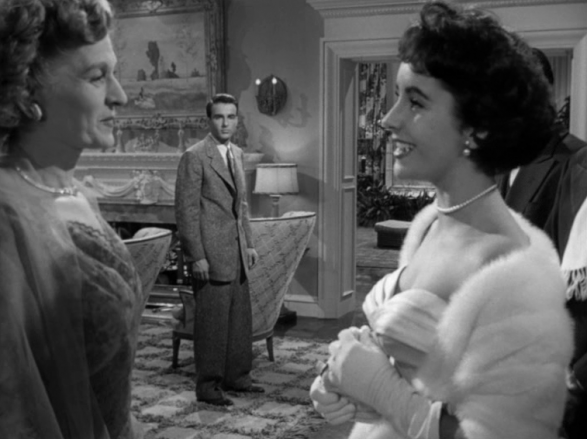
George Eastman (Montgomery Clift) is a young man from a working-class background who’s been given a chance to get ahead thanks to a wealthy family connection. But we know from the moment we see him hitching a ride to his new job, he’s not going to have an easy time of it.


Clearly ambitious, George covets the American Dream. But though he’s attractive and personable and shares a respected name, he’s not readily accepted by the Eastmans and their circle. Nor is he able to make friends with his co-workers since his uncle has forbidden social contact between family and employees. George becomes infatuated with one of the smart set, Angela Vickers (Elizabeth Taylor), who chooses to ignore him or just doesn’t see him. Disillusioned, he falls into a relationship with Alice Tripp, a factory girl who’s as lonely as he is. Played by Shelley Winters, she’s a plain but friendly young woman who clearly relishes the attention.


George for a time seems content with it all. Though he’s uneasy flouting his uncle’s rules, he feels he’s not doing  badly – he has a steady job, some money to spend, a room, a car, a girl, perhaps a future. It’s a far cry from living at his mother’s mission, finishing his schooling  at home, and working as a bellhop.

But then fate begins to show its ultimately deadly hand. At the moment that George and Alice’s relationship becomes intimate, his uncle promotes him and invites him – now as one of them - to the Eastman home. He’s formally introduced to Angela who now sees him as an Eastman. She flirts shamelessly with him and the attraction between these two impossibly beautiful people is immediate and intense.


However, it doesn’t take long for things to start to unravel. Alice announces to George that she’s pregnant and although at first he insists that he’ll marry her, he begins to retreat from her as he’s drawn further into the Eastman circle and to Angela. His place in the sun, now tantalizingly close, is all he can think about. Alice, angry at being neglected, threatens to tell all and undo the idyllic romance. George is distraught. His relationship with Alice is now the only barrier to the fulfillment of his dream. He feels that the fates are conspiring to send his life spiraling out of control. However, what he thinks of as ‘the fates’ could be his own moral frailty – the actions he’s taken, the choices he’s made, and his inability to deal with the consequences.


But then Angela suddenly provides George with what he thinks could be a solution to his problem. In passing, she mentions a drowning at the lake. He listens carefully. Angela has become an accidental femme fatale who causes him to stumble into a classic dead-end street where murder looks like the only way out. George moves ahead with a plan to kill Alice, but it’s hastily conceived and it’s clear that he’s ill-equipped to commit such a crime.


He takes Alice rowing on the lake but what happens is not what he’d planned. At the critical moment, he’s unable to kill her. Then Alice accidentally stumbles and falls into the water. Panic-stricken, unable to swim, she will drown. George has a chance to save her (as well as himself) but is unable or unwilling to do so and Alice dies – exactly as he’d wanted.

What is George to do? He could report the accident and face up to the consequences. But if he did report it, would anyone believe him? He had set out with the intention of killing Alice and given his premeditation, his innocence might be hard, if not impossible, for him to argue. The line between guilt and innocence is blurred at best. We know Alice had told George that she was afraid of water and couldn't swim. We see his reaction to Angela’s telling of the drowning at her lake. We watch him listen to the news report on weekend accidents with aroused interest. We listen to him lie to Alice with greater frequency and ease. We feel his anticipation as a plan takes form. And in the end, Alice dies because he makes no attempt to save her.


With his religious upbringing, George knows that guilty thoughts count as much as guilty deeds. There is no way out – he is doomed and he knows it. With scarcely a word in his own defense, he succumbs to the inevitable - capture, trial, condemnation. Unwilling to act to save his intended victim’s life, he’s unable to move to save his own. His loss of moral certainty, his vision of himself as the victim (rather than Alice or even Angela), and his inability to see the inevitable and tragic consequences of his actions place him at the very center of the noir universe.

Visually, A Place in the Sun registers as high noir. High-contrast lighting and multiple off-angle camera shots emphasize the drama’s overwhelming sense of despair. In one striking scene, George is on the first day of his new job only the morning after Alice has told him she’s pregnant. The film’s director George Stevens frames his interiors to suggest George trapped in a cage – an indication of his state of mind and a foreshadowing of the prison cell waiting. Stevens even subverts our appreciation of exteriors of great natural beauty, rendering them ominous and ill-disposed.


Costuming in A Place in the Sun also is central to its sense of noirness. Angela is dressed either in white or in black depending on whether she’s seen as part of George’s place in the sun or conversely as the catalyst for Alice’s death. George is dressed in light tweeds on his first visit to the Eastman family and is both dwarfed by the chair in which he is sitting and made invisible by the pillars and grandeur of the home. However, as he is accepted into that social circle, George’s clothing becomes darker and he increasingly dominates the scene.


A Place in the Sun is based on Theodore Dreiser’s epic novel, An American Tragedy, which runs over a 1,000 pages. Stevens replaces the sweep and detail of the novel with an intensity and focus that charts George’s incremental progression from an innocently ambitious young man to a confused, guilt-ridden wretch condemned for murder. As he’s led to his execution, his fellow inmates express the hope that he’s headed for a better world than the one he has known. Ironically, he was just beginning to know how good his world could have been. A place in the sun could have been his if he hadn’t been so blinded by the desire for it that he was prepared to do anything, even murder, to attain it. How could anything be more noir than that?


Valerie Deane

Friday, 5 February 2016

JAIL BAIT (1954)


By Gary Deane

“There is nothing is more exhilarating than philistine vulgarity.”  Vladimir Nabokov


Once upon a time, Friday night wasn’t Friday night on college campuses without a screening of one or both of Ed Wood’s famously bad Plan 9 from Outer Space (1956) or Glen or Glenda (1953), a demented cult classic that baffles to this day. The latter is notable for its groundbreaking if unhinged portrayal of LGBTQ issues (Wood himself was an enthusiastic cross-dresser, with a particular fondness for angora).  

Wood’s story is well-known (if not entirely understood),  thanks to Plan 9’s epic exposure on late-night television beginning in 1961, followed by its citing as ‘The Worst Film Ever Made’ in Michael Medved’s best-selling book The Golden Turkey Awards (1980). Wood had become an object of cult fascination himself, an obsession fed by the release of Tim Burton’s Ed Wood (1994), one of The Best Films Ever Made Not to Receive an Oscar Nomination.  


In 1947, Wood came to Hollywood and began writing scripts and directing commercials and TV pilots along with several micro-budget westerns.  Glenda or Glenda was Wood’s first feature and it was a miracle that he ever got to direct another one.  However, two years later Wood teamed up with Alex Gordon, a writer from the UK and they set to work on a grungy little crime drama, Jail Bait. Gordon, who would go on to co-found American International Pictures, provided Jail Bait a semi-coherent storyline and some narrative flow, something to which few other Ed Wood films can lay claim. 


Jail Bait opens with Don Gregor (Clancy Moore), the wayward son of a world-famous plastic surgeon getting bailed out of jail by his sister, Marilyn (Dolores Fuller), for possession of an unregistered firearm. Keeping an eye out are the two cops in charge of the case, played by Lyle Talbot and a pre-Hercules Steve Reeves in his first shot at stardom. The pair knows that Gregor's fallen in with a low-rent gangster, Vic Brady (Timothy Farrell) who together have pulled off a couple of small-time heists.
  
When Don gets home, he grabs another gun and goes out to meet Vic. They go off to rob a movie theater, but not before the action cuts to a striptease show (in some expurgated versions of the film, it’s a blackface minstrel show), which has nothing to with anything. Later the robbery goes awry when Don panics and all hell breaks loose. Vic subsequently kills Don and forces Don’s father, a surgeon, into giving him a new face. However, the good doctor discovers his son's body at Vic’s apartment and makes plans to take his revenge.


Doctor Gregor is played by Herbert Rawlinson, a former silent-era leading man who scratched out a living afterward by taking any roles he could get, most of them uncredited.  It’s hard to say who gives the worst performance in Jail Bait but the winner might be Rawlinson, who has the lion’s share of bad dialog in a film that revels in it. As he says after a hard day at the office, “You know, I had to perform a very difficult operation this morning…and it was very strenuous and complicated. Plastic surgery seems to me at times to be very, very, complicated.” And, "This afternoon we had a long telephone conversation earlier in the day”. Maybe it was just as well that Rawlinson died the night after shooting his last scene in the movie. All this and sets and décor so impoverished and tacky that one of the biggest laughs comes when Fuller calls Brady a "cheap crook", only to have his girlfriend, Loretta (Theodora Thurman exclaim, “Cheap? Just look at the place! Vic is anything but cheap!” 

     
Given that the film's budget was only $21,000 for a 4-day shoot, Wood did well by it and there’s arguably something more to the production than might meet the uncommitted eye. Jail Bait is the closest Wood ever came to making a legitimate movie and entering the Hollywood mainstream. Though he was out of his depth as a director, especially with actors, the movie manages to be more enjoyable than a lot of the run-of-the-mill crime dramas and B noirs of the day far less suspenseful. Jail Bait’s wacko plot and daft dialog are all just part of the movie’s aberrant charm. It’s so consumed with its own internal logic and so thickly riddled with clichés that they almost stop being clichés and the movie takes on a strange, otherworldly sense of its own (Or almost of its own. Looking to cut corners, Wood used the same dream-like flamenco-guitar score as he did in Mesa of Lost Women, 1953).  

A big chunk of Jail Bait’s perverse allure can be credited to Timothy Farrell, an actor with mustachioed good looks, an authoritative baritone, and a smarmy, suspect manner. Farrell actually was purpose-built for film noir and played the lead in half a dozen crime titles involving Wood. The problem for Farrell was that he wasn’t that much of an actor and Wood was just about the only one who would hire him. But no matter how chintzy the production, incongruous the story, or cheap the patter, Farrell managed at least to give a conscientious performance, one often at sizeable odds with material. Maybe he just had ambitions at sizeable odds with reality. 


Farrell, born Timothy Sperl, grew up in Los Angeles and after serving in the Army Air Corps in WWII, got a job as a bailiff with the Los Angeles Marshal’s Office. Around the same time he started getting bit parts in low-rent B titles. The first was Test Tube Babies (1948) in which he plays a sympathetic doctor who counsels a young couple that there’s no shame or scandal in test tube fertilization and artificial insemination. Of course, the information is sandwiched between plenty of nudity, some wild parties, and cat fight.

Farrell’s bedside manner won him a similar part in Hometown Girl (1949) another ‘sex hygiene’ film that dealt with unwed motherhood. Both films had been produced by schlockmeister George Weiss who then cast Farrell as a scumbag gymnasium owner and drug pusher in a trio of crude quickies, The Devil’s Sleep (1949), Racket Girls (1951), and Dance Hall Racket (1953). The first of them was mostly an excuse to showcase endless lengths of female-wrestling and cat-fighting footage, the last a cheesy curio written by and co-starring stand-up social satirist and fall-down substance abuser Lenny Bruce who died of a morphine overdose at age 40.  


Shortly after, Farrell appeared in another seedy Weiss-produced title Paris after Midnight (1951) which boasted famous stripper, Tempest Storm. During production, Farrell along with everyone else on the set was busted in a highly-publicized vice-raid, never a good thing to happen to a sworn peace officer.

However, none of it seemed to stick and in 1954 life met art when his legal and theatrical careers dove-tailed in the George Cukor film, A Star is Born in which he was cast as an officer of the court. It happened again when Farrell secured a regular part as court bailiff in a late ‘50s television series, Accused, featuring, among others, Robert Culp and Pamela Mason.  
    
Farrell’s screen career ended in 1957. Meantime, he’d managed to hold on to his job in the Los Angeles County Marshall’s Office and rose through the ranks and was appointed County Marshall in 1975. He was fired four years later, following his conviction on corruption charges. 

The legacy of Ed Wood lives on with events such as the University of Southern California’s annual ‘Ed Wood Film Festival’ at which students are charged with writing, filming, and editing an Ed Wood-esque short film based on a predetermined theme. His movies were spoofed on the much-loved Mystery Theater 3000 and several remade as pornographic features. Many of his bizarre transvestite-themed sex novels have been republished.

Wood also established a theme with Jail Bait that he would return to several times: that weak-willed parenting can lead to disaster. This was hinted in Glen or Glenda, then given full-throat in Jail Bait and The Violent Years (1956), a juvenile delinquency yarn in which a rich and spoiled girl with indulgent parents forms a vicious girl gang with a penchant for robbing gas stations. It's just what happens. 


Gary Deane

NIGHT EDITOR (1946)

By Gary Deane Director Henry Levin never met a film genre that he didn’t like or — perhaps more accurately — that didn’t like him. Though ta...